Interactions, Components, and Skill

While views on skills will no doubt continue to be the subject of much debate, it’s worth asking what empirical footholds might help us move forward. Here, I’m going to discuss what requirements different conceptualizations of skill place on empirical results. Many of these discussions have already occurred in other domains of research, but it’s worth formulating them in sport-specific terms to aid understanding.
Typically, the term technique is used to refer to the execution part of a specific movement, and the term skill is reserved for the adaptive execution of that movement within a performance context. I’ll stick to that terminology here. Most people agree that the goal is to get to skill, the disagreements are largely to do with the process used to get there. Some argue that techniques need to be learned first while others feel this is not necessary.
It’s uncontroversial that we can visually pick out and label certain movements such as a tennis backhand or an inside of the foot pass in soccer/football, the question is how these movements relate to the larger temporal and spatial scales they are situated within. This is often spoken about in terms of transfer. The more independent a movement is from the context it’s embedded in, the less that context matters during training. Questions of transfer are largely questions about how many temporal and spatial scales of context need to be included in a definition of skill.
When we state the assumptions of the technique-first approach clearly, we can formulate them in empirically testable terms. Consider the common metaphor of a fundamental building block used to describe technique. A toy block can be taken from one structure and placed into another without much trouble.
The fancy word for this type of situation is component-dominant dynamics. What this means is that the outcome of interest is dominated by the contribution of independent components. To put it in sport-specific terms, this would mean that the best way to look at a rally in tennis would be to study the contribution of specific techniques such as a backhand stroke, footwork, serve etc. It should be no surprise that the component-dominant view would expect events in the rally to be more independent, but we need to spell out what this means empirically.
Component-dominant dynamics are also required to support common forms of explanation such as perceive - decide - execute. For the contribution of some putative mental process in this type of sequence to be analyzed, the temporal and spatial scale making up the sequence needs to be independent. Without this independence of scales the idea of a central generator becomes untenable.
Independence is a familiar concept in statistics. In this case, we are interested in independence in data formulated as a time series. Consider a series of flips of a fair coin; we do not expect that the current flip is impacted by the previous flip. Even if you have flipped five tails in a row, the odds on the current flip are still 50/50. The key part here is that independent events relate to one another via addition and subtraction. We can pick a flip out of the series and put it somewhere else and always going to be a 50/50. Sparing the technical details, this type of time series would be considered white noise.

Summing up, for the “train a technical component” view to be supported empirically, we would hope (likely need) to see a high degree of independence in time series data of the final skill (technique in context).
An alternative approach to training can be described by a tree metaphor. While we often think of a tree as the visible structure of a trunk, branches, and leaves, there is a root system of equal size and importance that we don’t see because it’s underground. From this perspective, trying to train an independent technique is like trying to transport a tree without bringing along the roots. Like a Christmas tree, it might be a nice decoration but it probably won’t survive for long.

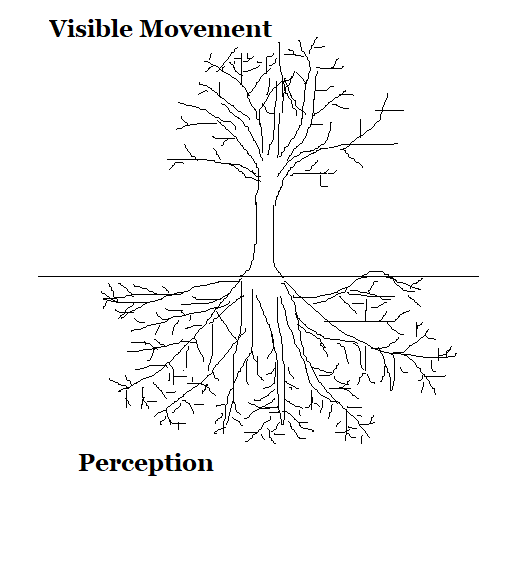
What are the roots in this metaphor? Well if the visible part of the tree stands for the action of the technique, the roots might symbolize the perceptual information that supports it. This idea has origins in ecological psychology and the understanding that we move to perceive and perceive to move.
So, what would the empirical expectations of an action-perception based understanding of skill be? The ecological or extended understanding of skill treats events quite differently than the component-based approach. Rather than expecting events to line up next to one another, events are expected to overlap in a nested fashion. Simply, small events inside medium events and medium events within larger events etc. Nested events will result in a time series that is very different from independent and additive white noise.

Because each level or scale of nested events builds on the next, the relationship is multiplicative. More precisely, we can look at the exponents or “scaling laws” that generate patterns in nested structures. Similar to the tree with the roots that can’t be seen, a small event like the purple on top might be supported by events at other scales.
For the sake of the example, let’s say that the purple represents the movement we identify as a backhand stroke in tennis. If the events are independent and relate additively, we should have no issue training a component and dropping it into the larger performance context. However, if the events are nested and relate multiplicatively, then we can’t neatly separate the backhand from the larger scales it’s nested within. Interactions between scales in the data are understood to result from interactions between scales in the performance (i.e. performer adapting to nested scales of performance environment). These multiplicative relationships appear in empirical time series as cascades and we have very robust methods for identifying cascades.
Rather than just being a “gotcha” in a debate, nested events, scaling laws, and cascades are some of the most powerful tools that have been developed in the natural sciences. It’s worth pausing for a minute and considering how many things exhibit these characteristics. We’ve gained tremendous insights into earthquakes, weather patterns, avalanches, populations, extinction events, financial markets and countless other phenomena when we explore these interactions between scales. We are in a relatively early phase of this exploration in psychology and sports science, but the results are already piling up.
It’s up to us to choose if we want to ignore the results or dive into them headfirst and move into an exciting new era for sport.
Note: I’ve kept the mathematical details to a bare minimum but I’m happy to discuss in more depth with anyone who is interested.
Further (freely available) reading for those who would like to learn more:
Self-Organization of Cognitive Performance
Multifractal Dynamics in the Emergence of Cognitive Structure
The Role of Fractality in Perceptual Learning: Exploration in Dynamic Touch
Multifractal Analysis of Movement Behavior in Association Football
Fractal Dynamics in Dexterous Tool Use: The Case of Hammering Behavior of Bead Craftsmen